
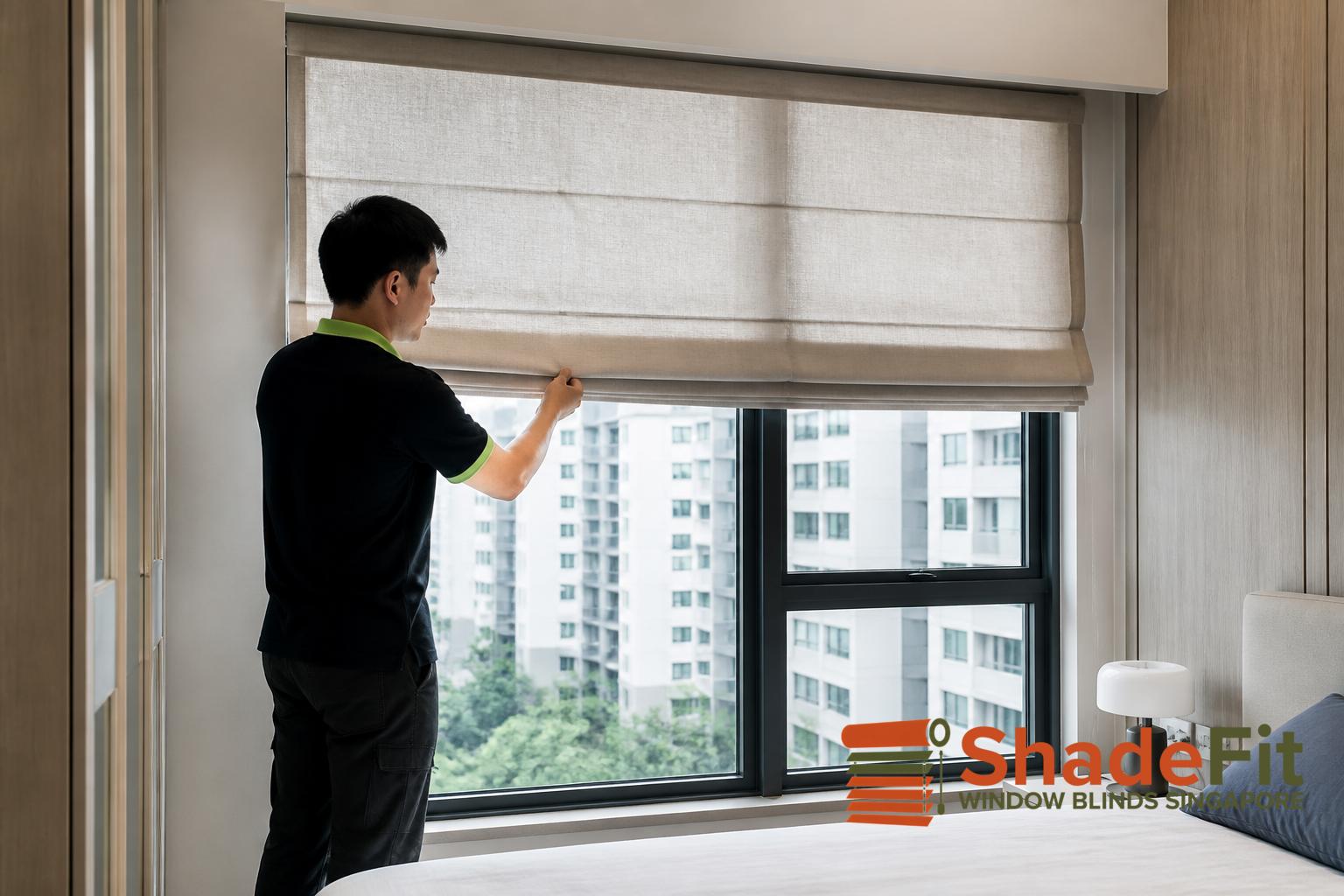
Measuring Roman blinds correctly is especially important for Singapore HDB homes, where windows can vary in size, depth and mounting space from one flat to another. A precise measurement helps the blinds sit neatly, operate smoothly and suit the window’s layout, whether they are intended for the living room, bedroom or study. It also reduces the risk of awkward gaps, poor light control or a finish that looks out of proportion.
Why accurate measurement matters for HDB windows
Roman blinds are fabric blinds that fold into neat horizontal pleats when raised. Because the material stacks up as it opens, the finished fit depends on both the window dimensions and the mounting method. In an HDB setting, this is particularly relevant where window grills, handles, ledges or air-conditioning trunking may affect installation space.
A careful measurement ensures the blind provides the intended privacy and light control without catching on surrounding fixtures. It also helps determine whether an inside mount or outside mount is more suitable for the window opening.
Choosing between inside mount and outside mount
The first step is deciding how the Roman blind will be fitted. An inside mount is installed within the window recess for a cleaner, built-in appearance. It works best when the recess is deep enough and the opening is fairly square. This is often preferred where homeowners want the window frame to remain visible.
An outside mount is fixed on the wall or ceiling outside the recess, covering a larger area around the window. This option is useful when the window recess is shallow, uneven, or obstructed by a grill, handle or other fixture. It can also help make the window appear larger and improve light blocking at the edges.
How to measure the width correctly
For an inside mount, measure the width of the window opening at the top, middle and bottom. HDB windows are not always perfectly uniform, so it is wise to record all three measurements and use the narrowest one. This helps the blind fit without rubbing against the sides.
For an outside mount, measure the width of the area you want the blind to cover, not just the glass opening. Many homeowners allow extra overlap beyond the window frame to improve privacy and reduce side light. The exact allowance depends on the room and how much coverage is needed around the opening.
- Inside mount: Measure the internal recess width at multiple points.
- Outside mount: Measure the full coverage area, including any desired overlap.
- Record in millimetres: This gives a more accurate result than rounding to the nearest centimetre.
How to measure the height properly
Measure the height from the top edge to the bottom edge of the intended coverage area. For an inside mount, this usually means measuring the recess height at the left, centre and right sides. If the opening is slightly uneven, use the longest practical measurement, depending on the blind type and installation guidance.
For an outside mount, decide how far above the window the blind should start and how far below it should end. In some HDB bedrooms, homeowners prefer the blind to extend beyond the frame for better privacy and to reduce daylight spill. In living areas, the blind may simply cover the full window opening with a modest margin.
Checking depth, obstructions and window details
Roman blinds need enough depth if they are being mounted inside the recess. Before taking final measurements, check for window handles, latches, grills, curtain tracks, concealed pipes or air-con fittings that may interfere with the blind stack or bracket position. Even a properly measured blind may not work well if these elements are ignored.
It is also worth noting how the window opens. Some HDB windows tilt, slide or swing in a way that affects where the blind can sit. If there is limited clearance, an outside mount may be the more practical solution. A short site check can save time and prevent the blind from fouling against fixed hardware.
Considering the fabric stack and finished look
Roman blinds do not lie flat when fully raised; the fabric folds into a stack at the top. This means the blind needs space above the window opening for the raised stack to sit neatly. When measuring, think beyond the glass size and consider how much headroom is available, especially in smaller HDB rooms.
The fabric thickness can also influence the final appearance. Heavier materials may create a deeper stack, while lighter fabrics can look more compact. For that reason, the measurements should always be paired with the chosen fabric type and lining, particularly if the blind is intended for bedrooms where stronger light control is desired.
Room-by-room measurement priorities in an HDB flat
Different rooms call for different measurement priorities. In bedrooms, homeowners often focus on privacy and reducing early morning light, so a broader outside mount may be preferred. In the living room, the aim may be to balance daylight with a tidy appearance, making exact recess measurements more relevant.
In kitchens or service yards, Roman blinds are less common, but where they are used, practical considerations such as moisture, cleaning access and surrounding fixtures matter. For study rooms, the main concern may be glare control and a neat finish that does not distract from work or screens.
Common measuring mistakes to avoid
One of the most frequent errors is measuring only once. It is better to measure twice and compare the results across the top, middle and bottom. Another common mistake is using the old curtain rod or existing blind as a guide without checking whether the current fit is accurate or suitable for the new Roman blind.
Homeowners also sometimes forget to account for the blind’s operating space. The raise-and-lower mechanism, stack height and mounting brackets all need room to function properly. Small measurement errors can lead to uneven edges, visible gaps or a blind that sits too close to the window handle.
- Do not assume all HDB window openings are identical.
- Do not ignore grills, handles or air-con fittings.
- Do not rely on guesswork for recess depth.
If you are planning Roman blinds for an HDB flat and want help checking sizes, mounting options and suitable fabric choices, you may WhatsApp ShadeFit Window Blinds Singapore – Venetian & Roller Blinds to discuss the window layout and request a quotation based on your room, sunlight direction, privacy needs and installation requirements.
Conclusion
Measuring Roman blinds for Singapore HDB windows is not difficult, but it does require attention to detail. The right fit depends on whether the blind is mounted inside or outside the recess, how much clearance is available, and whether nearby fixtures affect the installation. By taking width, height and depth carefully, homeowners can achieve a cleaner finish and avoid unnecessary adjustment later.
For HDB residents, the best approach is to measure methodically, note any obstructions and consider how the blind will be used in each room. That extra preparation makes it much easier to choose a Roman blind that fits well and functions as intended.
Choose ShadeFit Window Blinds Singapore – Venetian & Roller Blinds
ShadeFit Window Blinds Singapore – Venetian & Roller Blinds Singapore offers a range of products and service options suited to different window sizes, room uses and interior preferences. We help homeowners select window blinds based on the direction of sunlight, the level of privacy required and the overall look of the space. Our blinds selection includes roller blinds for a clean and practical finish, while venetian blinds allow homeowners to adjust the direction of incoming light. Combi blinds, Korean blinds and Shangri-la blinds offer layered designs for homeowners who want to balance light, privacy and appearance. Smart blinds and motorised blinds provide more convenient everyday control, particularly for wide or difficult-to-reach windows. Careful measurement and professional installation help ensure the selected blinds are fitted neatly and correctly.
For homeowners who prefer a softer window finish, our curtains selection includes blackout curtains for stronger light coverage, a day curtain and night curtain combination for flexible privacy, and dim out curtains for a gentler level of light control. Smart curtains and motorised curtains make daily adjustments easier and more convenient.
View our completed projects and read our blog before choosing what works best for your space and WhatsApp us at +65 8241 0032 today to discuss your window requirements to receive suitable recommendations.
Frequently Asked Questions
Should Roman blinds be measured in centimetres or millimetres?
Millimetres are generally better because they give a more precise result, especially when dealing with HDB window recesses and installation clearances. Even small differences can affect the final fit.
Can I use the same measurements for all windows in my HDB flat?
Not usually. Window sizes can vary slightly from room to room, and each opening should be measured separately. This is especially important if you are fitting Roman blinds to both bedrooms and living areas.
What if my HDB window has a grill or handle in the way?
If a grill, handle or other fitting reduces the available space, an outside mount may be more suitable. The blind can then sit outside the recess and cover the window properly without interfering with the obstruction.
